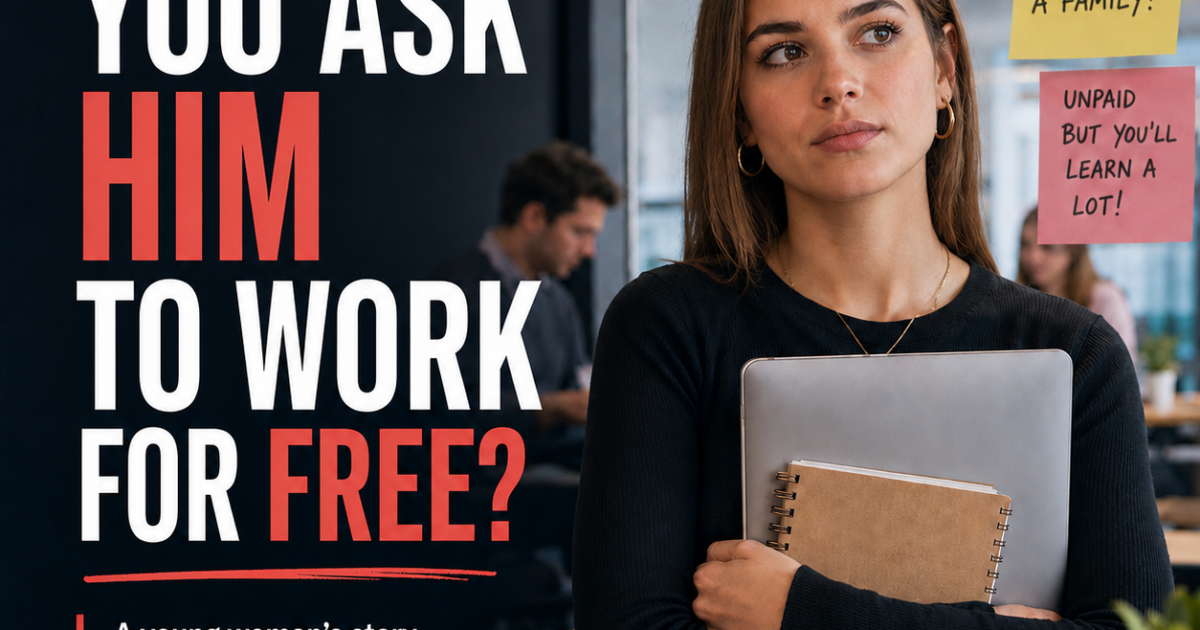
This summer, I spoke with two young women about their unpaid internships in New York City.
After they told me their stories, I asked one question: “Are any of your male friends working unpaid internships?”
Dead silence.
Then the answer: no.
I think they were shocked. Unfortunately, I was not.
What disappointed me even more was that both internships were with women-owned businesses. How can we talk about advancing women while asking the next generation of women to work for free?
I’ve been asked to speak at conferences with no compensation. I say no.
Experience matters. Opportunity matters. But so does valuing someone’s time, talent, and work.
This is not good for women, and it is not good for the workforce.
Here is one young woman’s story.Professional Experience at a Price: Entering the Workforce as a Young Woman
When an Internship Stops Feeling Like a Learning Experience
As a rising college senior entering the job market, it often feels as though proving myself means accepting any opportunity I can get, including unpaid work.
This summer, I accepted an unpaid social media marketing internship. The experience made me think more deeply about the pressure students face to build impressive resumes before they even graduate.
Instead of employers competing to hire undergraduate and post-graduate students, many students feel they have to accept unpaid roles simply to move forward in their careers.
In my case, that pressure was even greater because my university requires students in my major to complete an internship for credit before graduating.
I found my position through my university’s career counselor, who provided a list of internships that had previously qualified for credit. At first, that made the process easier because I knew the role would count toward my degree.
But it also raised a larger question: What happens when unpaid work becomes tied to the ability to graduate?
Internships are supposed to provide learning, mentorship, and preparation for a future career. Yet the growing pressure to secure one can put students in a position where they feel they have to accept whatever is available.
That can mean giving a company their time, energy, and skills without compensation.
I began questioning this even more when some of the work I was asked to do no longer aligned with the responsibilities of my internship.
As a social media marketing intern, I expected to spend most of my time creating content, learning about marketing strategy, and understanding how a business uses social media to reach its audience.
I have done some of that, and I have learned from and enjoyed those assignments.
However, there have also been times when I was asked to vacuum carpets or deliver materials to employees.
I have always believed that no task is too big or too small, and I understand that workplaces sometimes need people to help in different ways.
Still, when the position is unpaid, those assignments make me question whether I am being treated as someone who is there to learn or simply as extra help.
Would a Male Intern Be Asked the Same Thing?
I also began wondering whether a male intern in the same position would be asked to do the same things.
Young women who are still trying to prove themselves are often expected to be helpful, flexible, and agreeable. It can feel as though saying yes to everything is part of being considered professional.
When I look at the internships my male friends have, almost all of them are paid.
Their work is treated as serious professional experience worthy of compensation. My role, by comparison, provides college credit but no financial compensation.
What makes this particularly disappointing is that my internship is with a women-owned business.
That was initially part of the appeal of working there. I thought it would be an environment that understood the importance of supporting young women entering the workforce.
Instead, the experience has made me question how a women-owned business can participate in a system that may still undervalue young women and their work.
Experience Matters. So Does Compensation.
I do not believe every unpaid internship or professional opportunity is pointless.
I have learned from this experience, and it has helped me grow professionally.
But there is a larger issue worth discussing.
Supporting young women should mean more than offering them experience. It should also mean recognizing the value of their time, skills, and labor.
As young people enter the workforce, experience should help open doors. It should not automatically require them to work for free.